
Why so many businesses end up rebuilding their website
The scenario is common: a brochure website set up quickly with an online builder, then a store added with another solution, then a spreadsheet for stock and separate invoicing software. Each tool works, but none of them talk to each other. Orders are re-entered, stock levels drift apart and customer records are duplicated.
The day the business wants to manage supplier purchases, sell in several countries or track prospects, it has to choose between stacking yet another tool or migrating everything. Migration takes time, puts search rankings at risk and means retraining the team. The problem is not the initial choice of a simple tool, but the lack of a growth path.
Define the useful minimum for launch
A first website does not need to do everything. It must present the offer clearly, build trust and make it easy to get in touch or buy. Start by listing what a visitor should be able to do on their very first visit.
Everything else, such as loyalty programs, comparison tools or advanced customer accounts, can wait until the first sales show what customers really ask for.
- Understand what you offer and who it is for
- Find your contact details, service area or terms
- Browse a few flagship products or services
- Pay online or request a quote
- Find you on a search engine thanks to well-titled pages
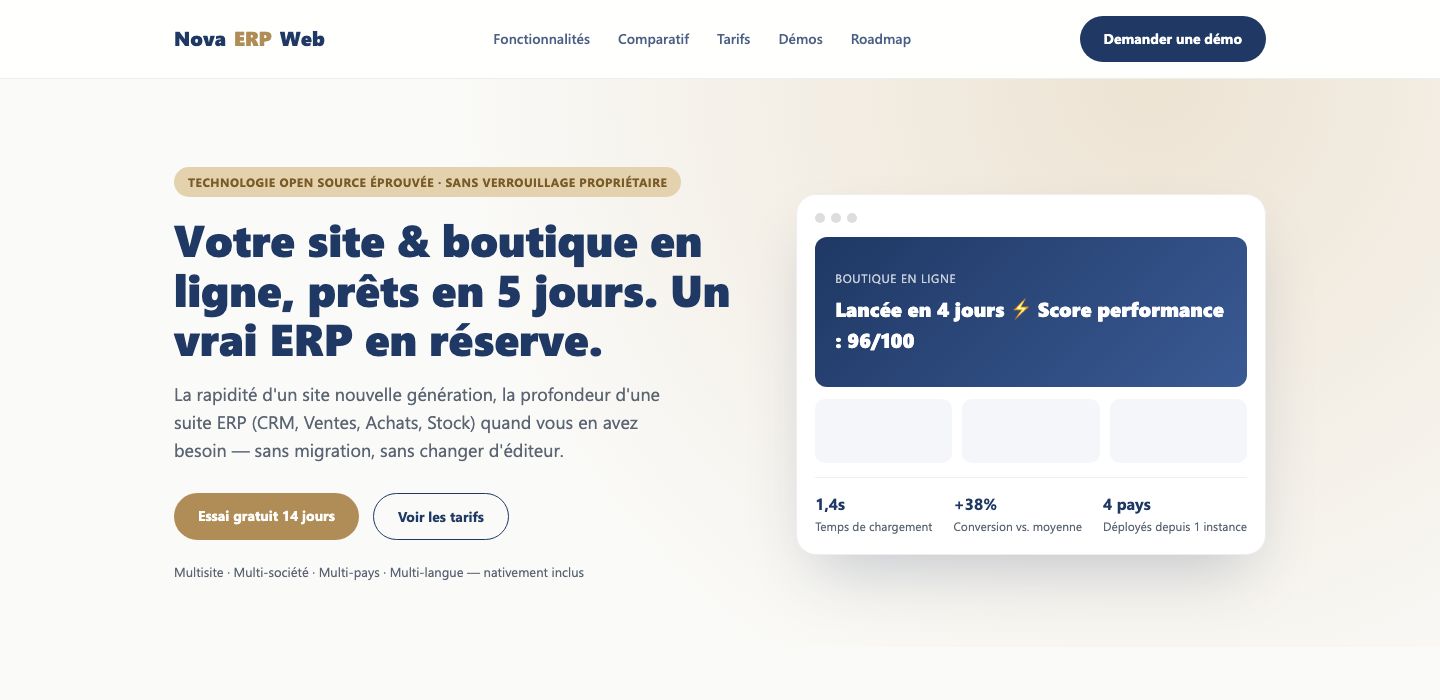
Launch a brochure website and an online store on an open-source Odoo foundation, then activate CRM, sales, purchasing and inventory in the same place, with no migration.
Explore the solutionCheck the growth path before choosing the tool
The key question is not “which tool is simplest today?” but “what will happen when I need to manage stock, suppliers or several websites?”. Ask it of every solution you consider and request a concrete answer: will you need to migrate, add a module or change vendor?
- Do store orders feed stock management directly?
- Can CRM, sales and purchasing be added without changing platform?
- Can the website handle several languages, brands or countries if needed?
- Can the data be exported if you switch solutions?
- Does the cost remain clear at each stage of growth?
An example of a scalable foundation: Omnifloo
Omnifloo, a solution published by Dyonysos and built on Odoo, illustrates this approach. The offer starts with a brochure website, adds an online store with payment and stock management, then lets you activate CRM, sales, purchasing and inventory in the same place, with no data migration and no change of vendor. The publisher states that the website and store can be ready in 5 days.
The foundation is open source (LGPLv3 license), which keeps code and data portable, and it natively supports multiple websites, multiple companies and multiple languages. Industry themes serve as a starting point, with online demos of a landscaper’s brochure website and a coffee roaster’s online store. A free plan lets you test a three-page brochure website before choosing a paid plan.
Grow the system step by step
Once the website is live, move forward based on observed needs rather than a wish list. Activate the store when purchase requests come in, stock management when stock-outs or discrepancies become costly, CRM when prospect follow-up slips through the cracks, and purchasing when supplier orders multiply.
At each step, set a simple indicator: store conversion rate, number of re-entries avoided, time taken to process an order. That indicator will tell you whether the next step is worthwhile, and when.
FAQ
Should the website and the store be launched at the same time?
Not necessarily. If you mainly sell face to face or by appointment, a well-built brochure website may be enough at first. What matters is that the chosen foundation lets you add the store later without rebuilding the website.
Is a tool like Shopify or Wix a bad choice?
No, they are effective solutions for launching a website or a store. The question is what comes next: if you plan to manage stock, purchasing and customer relations in a single system, check from the outset how those needs will be covered and at what cost.
How can you avoid losing search rankings when changing tools?
Keep the same page addresses wherever possible, set up permanent redirects for those that change and carry over existing titles and descriptions. The safest option is still to choose a foundation that avoids migration altogether.
Need a demo or a project review?
Dyonysos can present Omnifloo, study your use case and design a test suited to your context.
Contact us