
Step 1: the brochure website, to be found and build trust
A brochure website answers a simple question: can a customer who hears about you quickly check what you do, where and for whom? For a tradesperson, a professional practice or a service company, that is often the core of the digital need at the start.
Take care of the pages that drive the decision: presentation of the offer, past work or references, service area, contact. Give each page a title and description that match what your customers search for: this is the foundation of local search visibility.
Step 2: the online store, when the sale can happen without you
A store makes sense when some products or services can be bought without a quote or a conversation: fixed price, clear specifications, organized delivery or pick-up. If every sale requires a discussion, a well-designed quote request form may be more useful than a shopping cart.
- A stable catalog with reliable prices and descriptions
- Defined delivery, pick-up and return terms
- An online payment method suited to your customers
- Someone responsible for processing orders every day
- Stock tracking, even a simple one, so you do not sell what you no longer have
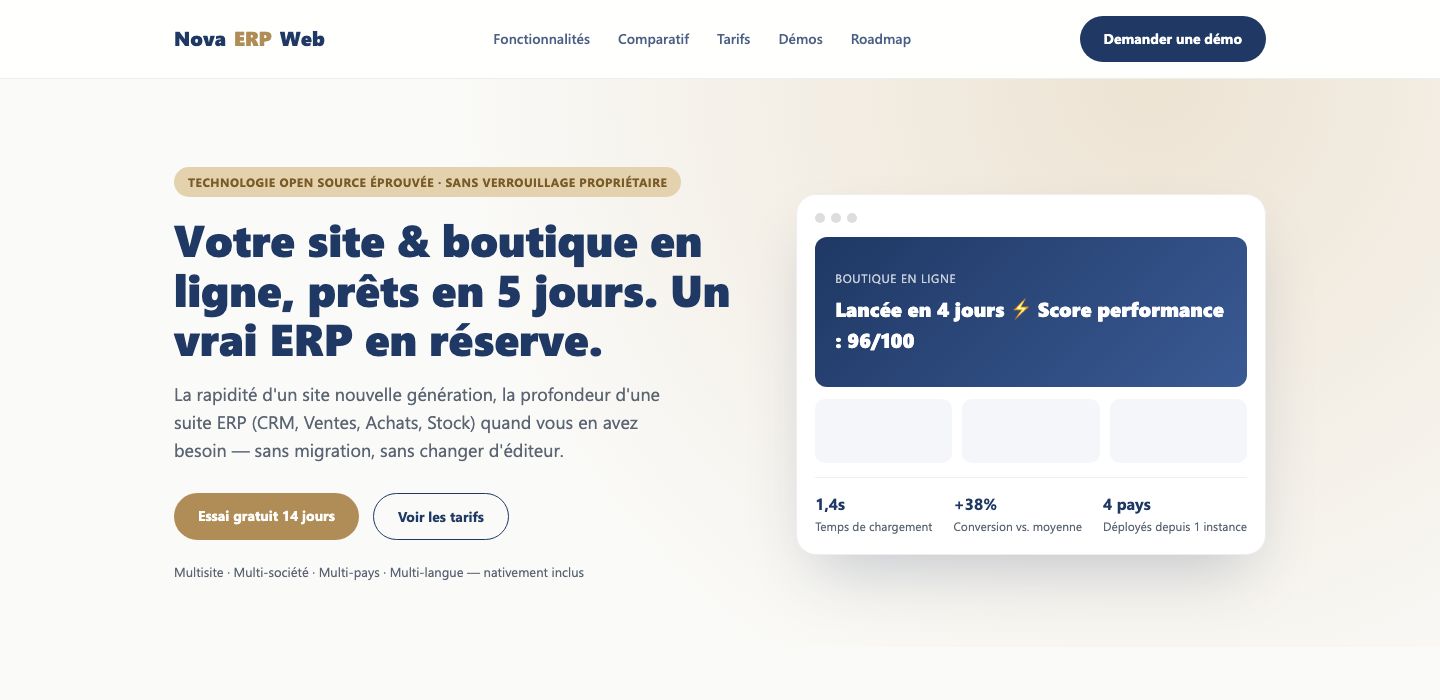
Launch a brochure website and an online store on an open-source Odoo foundation, then activate CRM, sales, purchasing and inventory in the same place, with no migration.
Explore the solutionStep 3: the ERP, when re-entering data costs more than the tool
An ERP brings sales, purchasing, stock, invoicing and customer relations together in a single database. It becomes relevant when information flows poorly between these functions: orders re-entered by hand, inaccurate stock, forgotten customer follow-ups, margins that are hard to reconstruct.
The signal is not the size of the business but recurring friction. For a few weeks, note every re-entry and the errors it causes: if the list keeps growing, the cost of a unified system becomes easier to justify.
Choose a foundation that lets you move from one step to the next
The trap is choosing each tool in isolation: a website builder, then a store solution, then an ERP that forces you to start over. Each transition requires migrating products, customers and sometimes page addresses.
Another route is to start from a single foundation where these steps are modules to activate. This is the principle behind Omnifloo, an offer published by Dyonysos on Odoo: a brochure website first, then a store with payment and stock management, then CRM, sales, purchasing and inventory in the same system, with no migration. The foundation is open source, which keeps the data exportable.
Whatever tool you choose, ask the same question at each step: what will have to be redone or migrated to move on to the next one?
Adapt the order to your situation
This order is not an absolute rule. A retailer that already manages significant in-store stock may need unified management even before opening an online store. Conversely, a service business may stay on a brochure website with an appointment booking tool for a long time.
- You mainly sell on quotation: brochure website, then CRM
- You sell fixed-price products: brochure website and store quickly, then stock management
- You have several outlets or entities: plan for unified management from the start
- You are targeting several countries: check multilingual and multi-company support early
FAQ
Can you skip the brochure website and open a store straight away?
Yes, if your offer sells without prior explanation. The store then includes the essential presentation pages. Just make sure that reassuring information, such as terms of sale, contact details and legal notices, is easy to find.
When does an ERP become useful for a small business?
When re-entering data between sales, stock, purchasing and invoicing becomes frequent and causes errors. It is not a question of revenue, but of how information flows between functions.
Should everything be set up at once to save time?
Rarely. Activating too many functions at once makes training heavier and delays going live. It is better to have a foundation that lets you add modules when the need arises.
Need a demo or a project review?
Dyonysos can present Omnifloo, study your use case and design a test suited to your context.
Contact us