


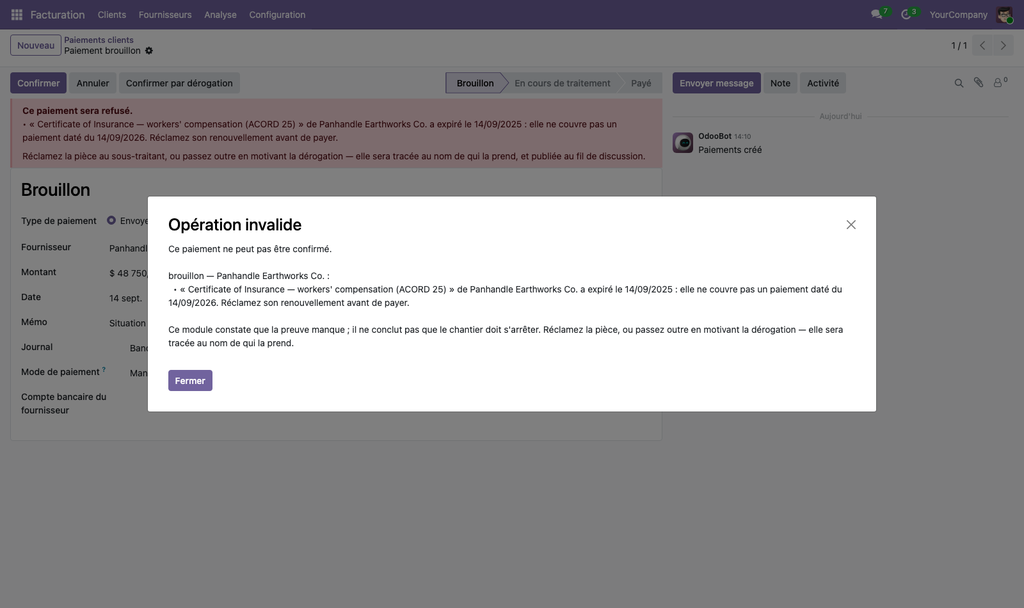
Subcontractor Insurance Compliance, full edition — refuses to post a supplier payment when the subcontractor's certificate of insurance or workers' compensation clearance has expired at the payment date, with a written and traced override. Plus classification codes, rates, experience modification and payroll declarations.
Overview
Subcontractor Certificates and Workers' Compensation Insurance — full edition
Full edition, for Odoo 19 Community. It extends the free register dyo_attestations_na_lite with the one action no external portal can perform on your behalf.
The action that drives the purchase
This module refuses to confirm payment to a subcontractor whose certificate has expired.
Subcontractor certificates are already handled, outside the ERP, by subscription portals: ISNetworld and Avetta in the United States, myCOI, TrustLayer and Billy in the same space, Aprovall and Provigis in France. They collect the document, date it, track its expiry and write to you. They do all this very well.
None of them can stop your accountant from clicking “Confirm” on Friday's transfer. That click happens in the ERP, and the refusal has to happen there too. That is where the only thing that truly costs money is decided: the money has gone out, and the proof was missing.
How the refusal is built
The check is assessed as of the payment date, not today's date. A certificate that expired the day before does not cover the next day's payment, and a certificate obtained after the fact does not prove what was known on the day the money went out.
The rejection names the document, the subcontractor and the expiration date. “Payment blocked” helps no one; “Panhandle Earthworks' certificate of insurance expired on September 14, 2025” can be resolved with one phone call.
Only a disbursement to a vendor tracked in the register is checked. A customer receipt, an internal transfer or a third party outside the register go through without triggering anything. An absurd block is the shortest path to a routine override, and a routine override no longer tracks anything.
Overriding remains possible, never silently. The override is reserved for the manager, requires a written reason, records the name of the person taking it and the date, and posts the list of blocks bypassed to the chatter. A “Payments under override” screen gathers them: it is the first list an auditor asks for.
The vendor bill, however, is not blocked. The debt exists, and accounting that refuses to record what is owed becomes false. The bill states the finding plainly — what will be missing at payment time — without preventing anything.
Three modes, and the strictest is the default. “Block the payment” out of the box; “log in the chatter” for the first few weeks, while catching up on a register that is behind; “no check”. A compliance module whose check is switched off out of the box protects no one, and no one thinks to switch it on.
Classifications, rates and fringe benefits
No rates and no classification codes are provided. This is not laziness, it is how the system is structured. NCCI is a private rating bureau: it proposes rates to states, which approve, modify or ignore them, and several states have their own bureau or their own fund. In Canada, each provincial board publishes its own schedule of classification units. The same occupation code does not carry the same rate from one state to another, and it changes every year.
A rate entered without its source is rejected by a constraint, not by a note. An unsourced rate will be taken as true without ever being rechecked, and it will end up in a signed return.
The rate unit is entered, never guessed — per hundred, per thousand, or as a percentage. A factor of one hundred in a payroll declaration does not show up on review.
The experience modification is entered, never calculated. In the United States, the factor is calculated by the competent rating bureau from loss data the ERP does not have, using parameters specific to each jurisdiction; in Canada, the personalized rate is notified by the board. Recalculating it would give a number different from the one that will be billed.
The return refuses to be filed as long as a classification has no recorded rate. Its line is not calculated as zero: a zero premium on a signed return looks like a completed return.
Portals: the API and its fallback
The module plugs into the source chain of dyo_connexions_base — it does not write a second one. It adds one question, “is this third party covered, and until when?”, and three services able to answer it.
The ISNetworld and Avetta connectors are shipped inactive, without a key, and marked “not tested in production”: neither vendor publishes API documentation accessible without an account, and neither the endpoint, nor the name of the header carrying the key, nor the shape of the response could be verified by a real call. URL, header and key can be edited on screen, and the response is read defensively.
The last link is the internal register — the one the free edition fills in by hand. It never goes out on the network, it always answers, and it returns the same response format as the others. A user with no subscription at all therefore has the full feature. A subscribed user sees the same thing fill in automatically. The workaround is the normal case here, not a shameful fallback — all the more so because these subscriptions are billed to the subcontractor, not the prime contractor.
The module records findings; it does not draw conclusions
It says that a certificate has expired and refuses the payment. It does not say that the contract must be terminated, or that work on site must stop. It produces a premium amount calculated from what it was given; it does not say that this is the amount due. The return remains the company's own.
What you need first
dyo_attestations_na_lite (the register, free), Odoo Accounting, and dyo_connexions_base for the source chain.
Specifications
| Price | €129 excl. VAT |
|---|---|
| License | OPL-1 |
| Odoo series | 19.0: published on the Odoo Apps Store; 20.0: published on the Odoo Apps Store |
| Version | 1.0.0 |
| Edition | Odoo Community / on-premise |
| Technical name | dyo_attestations_na |
| Domain | Accounting and finance |
| Free version (lite) | dyo_attestations_na_lite |
Price excluding VAT as displayed on the Odoo Apps Store; purchase and installation are done on the Store or through your Omnifloo instance.