
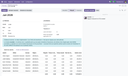


Quebec CCQ monthly employer report and collective-agreement wage grid for Odoo 19. Aggregates the daily register into the monthly return, computes the 15th-of-next-month deadline from a dated regulatory record, states the lateness penalty tier the R-20 Act attaches to the delay, and compares what was actually paid with the agreement rate, day by day. Ships with an EMPTY rate grid on purpose: construction wages live in four sectoral agreements and the module never guesses one.
Overview
CCQ — full edition: the monthly report and the rates
Full edition, for Odoo 19 Community. It extends the free register dyo_ccq_qc_lite with the two actions that cost money when they are missed.
The action that drives the purchase
Comparing what was paid with what the collective agreement required, day by day. Neither the Commission de la construction du Québec nor a payroll provider does this upfront. The CCQ does it after the fact, during inspection, and by then it is too late: the amounts are claimed, with interest.
The module reads the rate grid, finds the line that matches the trade, sector, region and apprenticeship period of the day, and records the difference. It draws no conclusion: a bonus, a tool allowance, a higher rate under a letter of agreement, an apprenticeship period entered the day before — all of these create legitimate differences that only the employer can explain.
The monthly report, and what a delay costs
Choose a period and click Prepare: the module rereads the daily activity register and aggregates hours by employee, trade, sector and region. It calculates the due date — the fifteenth day of the following month — from a dated record carrying its source, never from a constant.
Once the submission date is entered, it records the delay and names the penalty tier that the R-20 Act attaches to it: seven percent up to seven days, eleven beyond seven and up to fourteen, twenty beyond that. It invoices nothing and posts no journal entry: the penalty applies only to insurance, pension and vacation pay contributions, daily interest is added on top, and the amount invoiced by the CCQ prevails.
The rate grid ships EMPTY, and that is the point
Construction wage rates in Quebec are not a single data point: they come from four sector-based collective agreements, renegotiated every four years, with a wage schedule per trade, a column per apprenticeship period and regional premiums. They change during the term of an agreement, through letters of agreement.
The module therefore ships the grid that holds them — trade, sector, region, period, validity period, cited collective agreement, URL, date consulted — and no rates. As long as a line is missing, the calculation is refused, and the refusal names exactly the line to create. A module that guessed a construction rate would be worse than nothing: it would give the illusion of a control.
The API and its workaround — here, the workaround is the normal path
The CCQ publishes no public API. Its online services require a registered employer account; the only documented machine channel is a file upload, whose schema is published only to authorized payroll service providers.
The module plugs into the source chain of dyo_connexions_base and adds one question — “is this certificate of competency valid, and until when?” — with two services: the CCQ online services, shipped inactive and not tested in production, and the internal register, the one the free edition fills in by hand. The latter never goes out over the network, always answers, and returns exactly the same form of answer. An employer without an account therefore gets the full feature.
The alert, once, never twice
A scheduled action creates an Odoo activity for the report whose deadline is approaching — and only one per report. It ships inactive: you enable it once the periods are entered, not before. An alert that fires on an empty database teaches users to ignore it, and they will also ignore it the day it is right.
What the module does not do
It transmits nothing to the CCQ, calculates no insurance, pension or union contributions, does not apply time-and-a-half or double-time premiums — their rules vary by collective agreement and have not been checked against their source — and does not produce pay slips.
Not proven in production
No live call has been made to the CCQ online services: they require a registered employer account. The upload file is a faithful rendering of the register and must be checked against the official template before use.
Specifications
| Price | €269 excl. VAT |
|---|---|
| License | OPL-1 |
| Odoo series | 19.0: published on the Odoo Apps Store; 20.0: published on the Odoo Apps Store |
| Version | 1.0.0 |
| Edition | Odoo Community / on-premise |
| Technical name | dyo_ccq_qc |
| Domain | Human resources, payroll and fleet |
| Free version (lite) | dyo_ccq_qc_lite |
Price excluding VAT as displayed on the Odoo Apps Store; purchase and installation are done on the Store or through your Omnifloo instance.